Showing posts with label DIY. Show all posts

Sonar Measuring Device

For my Maker Faire project, I wanted to make a cool electronic device. I heard about laser and sonar measuring devices, but the laser is very complex so I went with a sonar distance measuring device. This is a device that sends a very high pitched sound (higher than humans can hear) to a target and when the sound bounces back the device receives the sound and based on how long it took for the sound to come back it sends a certain pulse (a burst of electricity that lasts a certain time).

I coded my Microbit to convert that pulse into the distance based on an algorithm. The Microbit displays the distance to the nearest foot on the LED display. The Microbit was being powered by a battery pack and the Microbit was powering the sonar sensor and the sonar sensor was sending back out that electricity as a pulse, but there was a problem. Computers are made of 1s and 0s, which are represented by a voltage. X voltage and below would count as 0 and Y voltage to Z voltage would count as 1 (any above and the computer might fry) (X, Y, Z are random volts where X<Y<Z), but there is a gap between X and Y because any voltage in that gap might just be a vibration so . The pulse that the sonar sensor was sending was in that gap, so the Microbit couldn’t receive it. The sonar sensor was lowering down the voltage by 2 volts to the Microbit’s gap. So I got a mobile phone charger, which emitted more volts than the Microbit which is powered by batteries, connected it to a board and had two wires, one going to the Microbit and one going to the sonar. This phone charger gave the sonar a larger input than the batteries + Microbit, so the output (pulse) would be in the Microbit’s voltage range. But the pulse was above the Microbit’s range (an area where it would get fried), so I added three diodes which decreased the voltage to the 1 area so the Microbit would pick it up.

I had a really fun time making this. I learned from my dad about the range of 1 and 0 and the gap between which is really cool and I have a newfound respect for DIYers who use spare electronics to make things. In the future, I would like to make it more precise and accurate in its distance readings. I should say I want to make it all less messy or at least 3d print a case for it, but I know I don’t care enough about neatness to do so. If someone wants to do this I would recommend using an oscilloscope or something of that sort before plugging it into the Microbit because it is easy and not fun to fry it.

Estimated total cost: $45 (though the sonar sensor I already had from my dad’s old DIY drone, I had the Microbit, which I have used in previous projects, and the rest was stuff my dad had).
Links: https://www.maxbotix.com/Ultrasonic_Sensors/MB1000.htm,    https://microbit.org/code/,   https://www.maxbotix.com/documents/LV-MaxSonar-EZ_Datasheet.pdf


DIY Soccer Goal

Project Inspiration and Overview
Me and Jonas both play soccer and are very interested in the sport so we decided to build a soccer goal from PVC pipes. We also want to create cardboard targets on the goal to make a point system for kids to shoot and score points when they visit our project during the Maker Faire. Our overall goal for the project is to build an easy DIY soccer goal perfect for your backyard. The project could also be easily able to be taken apart, stored and carried around to the park or something.

Challenges and Solutions and Day by Day
At first we had problems picking our project that fit our soccer project desires and would be manageable in our small time period. We went through a full class period on Friday not knowing how or when to begin. We finally picked making the goal that following Monday. At first we did not have enough pipes and were distracted throughout that class period. Because of our lack of communication, no work was completed overnight. We solved this problem through the power of last minute panic and decided on a thorough plan on how to use our time overnight and in class wisely.
On Wednesday we began measuring and deciding for our measurements for the goal so I knew how long of PVC pipes I needed to get while not at school. Jonas began on the thought for the netting we were to make and we decided to weave it ourselves opposed to buying it. We went over the style of how we were to make the net and Jonas learned it for he was to be captain of the knot tying net making. We went over if i was to also buy more string as well but he said it wasn't necessary. At the store, there were no different size pipes so I had to settle for three ten foot long ones.
On Thursday, fifth period a study hall period was kindly given to us so we decided to learn how to cut the PVC pipes down to the size we desired. After that was done, we began the net. It started of very slow and tedious and it was hard. We had to watch the instructional video again to remember how to tie the knots. As we worked, we were so beaten we went over the idea of not having a net at all but we powered through and got much done by the final bell. (we even stayed a little after school)
On the final day of our project, the day of the faire itself I came to school to a desperate Jonas trying to fix the net he obviously messed up while working on it at home. I told him it was fine and we could try to fix it in time and if not it was fine we did not need it. Jonas continued to frantically work on the net as I did a few more PVC pipe cuts and started to build it. After I build it there was a moment of happiness and relief but it all fell apart, literally as the crumbled down when we tried to move it to the right spot. We obvious needed some PVC glue. Luckily, Mason and Zorian where there to help very conveniently with some glue. While Mason and Zorian helped me glue together the PVC pipes  as Jonas continued on the net. We just began to wrap up the project as guests started to arrive. as they flowed in, I even had some time to put up targets on the goal for a point systems and duct tape on the ground so people knew were to kick from according to grade. we did not really have time to admire the final product as more people were increasingly interested in the project. Overall, during the project we both learned that projects takes perseverance and thought. I think what we could have done better or what we would have done with more time would be maybe an electronic point system maybe. For someone who also might want to give this project a go I would say that a secure plan should be established for how the final goal while look like and how you will use all your inside and outside school time wisely. Make sure that you have enough materials for all parts of the project. For example, with us we had about 1/3 of the PVC pipes we needed at first and buying new ones was around $15. Also we have learned to be supportive of your partner and always be on the same page. All in all, our project was a success and we reached our goal and maybe even further. at the faire itself, we were a large attraction of kids of all ages.


Net Making Video

Tilda and Amelia's 2019 Maker Fair Blog Post


Our project was to make a flashlight in an Altoids tin. We wanted to learn about circuits and how they work. Our inspiration for our project was to make an accessible light source. One challenge we had was that we were new to circuits and needed to learn about them to understand our project. We learned about how circuits work. It took us a long time to figure everything out so if we did this a second time it would not take as much time. If we had more time we would try to make the flashlight, solar powered or make it easy to recharge the battery on a solar panel, so we could use a more sustainable energy source. Some advice we would give to others is to really research what you are doing before you get too far in. An estimated cost of our project if we had to buy everything except for the tools, would be about 10 dollars. This is a really cheap project that anyone can do if you have the knowledge, tools, and time. This is the tutorial we used. It did not explain how to solder the circuit so we had to get help.

String Ball Chandelier

For our school maker faire, we decided to build a chandelier. We made this chandelier out of string and glue. We were inspired to make this after watching a lot of DIY videos. We eventually landed on a video of DIY home decor. Here, we saw someone making a lantern out of string, but the instructions were not clear, so we found a better video and decided that this would be a fun project.


First, we blew up a beach ball and then drew two circles on the ball. We drew a small circle on the top for the light fixture and a bigger one for the opening of the chandelier and to put the light bulb in. We then dunked our base white into the glue and started wrapping the string around the ball, making sure to avoid the circle boundaries. Once we ran out of white string, we repeated the process with the blue and pink string. When wrapping the string, we made sure to cover up any blank spots on the beach ball so that the amount of string was consistent all around. After we finished wrapping it, we set it on a drying rack and let it dry. Once it was dry, we deflated the beach ball and took it out of the now-dry string ball and put in the light fixture and light bulb and hung it up.

A challenge we faced was not having enough materials necessary to complete the project, so we borrowed these materials from our BPC art classroom.

If you were to make this yourself, you would need about $20 worth of materials, and a few hours of getting your hands dirty with glue.

(Bonus: Once the glue on your hands dry, peeling it off will be very satisfying. :))


By: Christina Keung and Katie Wendelken 7A

Upcycled Fashion


The objective of our project was to reuse old clothes to make new “trendy” clothes. Our inspiration was seeing people throwing away perfectly good clothes when could just easily upcycle it, for example; when someone “throws away” a dress they could just make it into a top or/and a skirt.


One challenge we faced was not having clothes for the project. Since we didn’t want to spend money on the clothes because it would defeat the purpose of our project, we asked the people at our school if they had spare clothes they either don’t wear or don’t need anymore to bring it in, we also brought in some of our old clothes to upcycle.


In the process of our project we learned how to hand sew and how to manipulate the old clothes into new clothes. If we had more time, we would definitely upcycle more clothes and reach for bigger goals for the clothes we chose. If you do choose to do this project, make a plan for the things you’re going to upcycle, it’s better to see if you can improve on something before you start and mess it up and have no way of fixing it.


0$ spent on materials
3 hours spent on this project.


Maker Faire 2019 Bath Bombs- Eva FG and Sofie


DIY Bath Bombs
For Maker Faire, we decided to create our own bath bombs. We first discovered the idea on the Maker Faire website. They looked really fun, and you can customize them any way you like. Also, they are pretty simple and don’t have complicated ingredients. We didn’t end up using that recipe, but it inspired us to look up other recipes online. We decided to make four bath bombs, and to make them orange scented. Though making bath bombs isn’t exactly solving a problem, they are really relaxing and fun to use. We initially wanted to try marbling, but didn’t have enough time. One challenge that we faced, was not having the right molds. Instead, we used two measuring cups stacked together, which made the bath bombs turn out a completely different shape than the regular molds. We eventually found the regular molds and made the rest of the bath bombs with those. They had plastic parts inside that shaped them into smiley faces, which added a special touch. If we had more time, we would try more recipes to perfect the bath bombs, and try a variety of different colors and techniques. If we did these again, we would use plastic wrap inside the molds so they would come out more easily, because we had trouble with that. Also, we would make sure that we stirred fast enough in the beginning so it doesn’t lose it's fizz. Buying all the ingredients (including molds) would cost around $40, but it would make many batches of bath bombs. This was a really fun project and know we know how to make these for ourselves at home.

Turning Feed Bags into Clothing!


                                                  Turning Feed Bags Into Clothing!

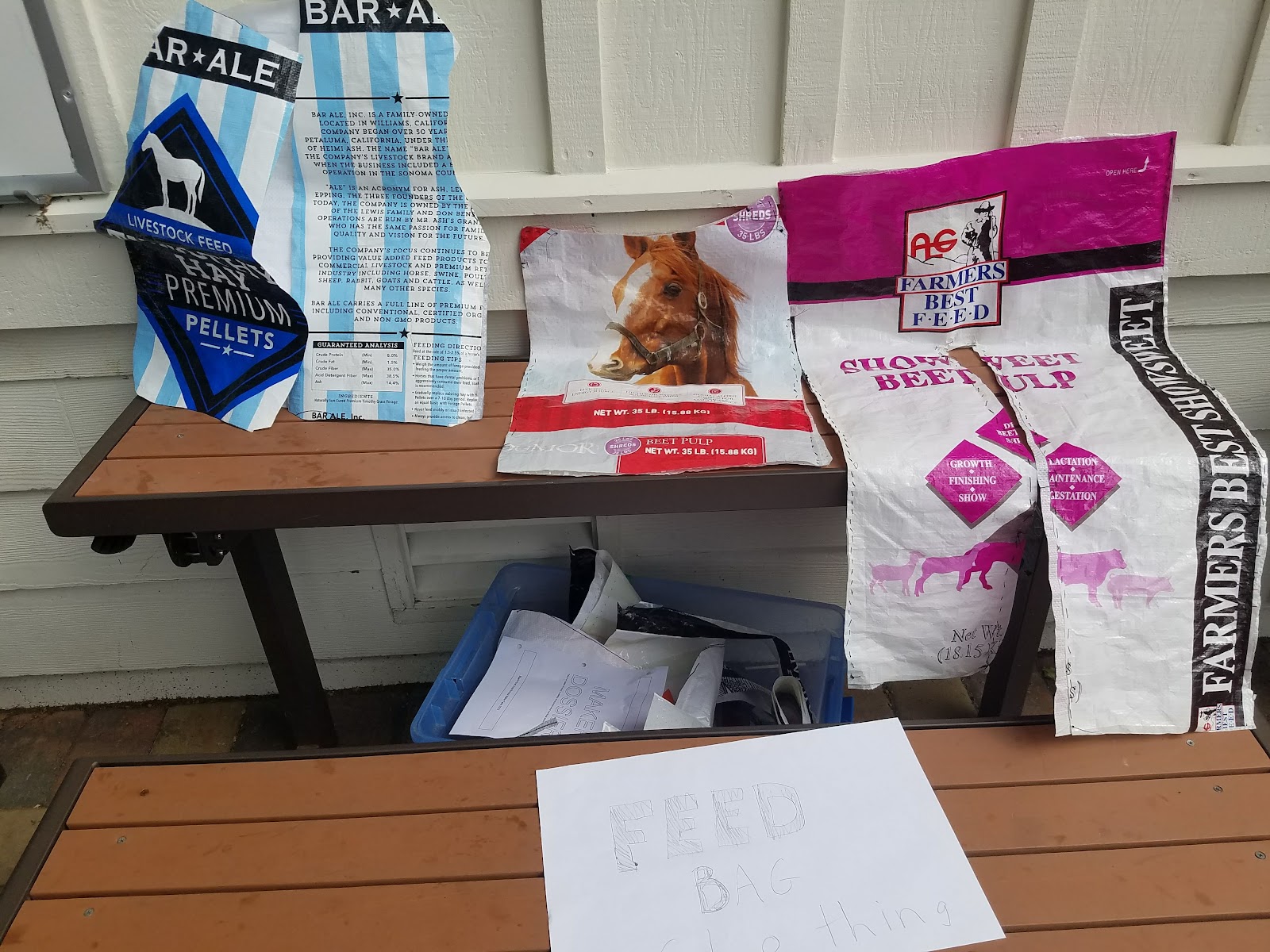
Our project was turning feed bags from Ms. Hill’s farm into clothing! The inspiration for this project was fashion and raising awareness for trash on earth. The objective was to make people realize how much trash there is on beaches and other areas on earth, and how easy it is to reuse things. We wanted to make clothes and since the theme was sustainability, we decided to use already used bags instead of using new plastic bags. Overall the project was hard, the feed bags were pretty hard to sew because they were made out of tough material, but we managed to get everything done in time.

A challenge we faced as a group was figuring out the designs ( like how to take the right measurements) and how to sew the feed bags. We overcame the challenge of figuring out the designs by collaborating and working on them together. We got past the feed bag problem by having lots of help from each other. We had planned on making pants, a t-shirt, and a jacket and got all three of them done in time for Maker Fair. Another challenge we faced was how to make the material stick together and stay that way.


What we learned was that people aren’t aware enough of climate change, there is so much trash on earth, and feed bags are hard to sew. Also a another problem we faced, when you work together you can finish any hard project. If we had more time we would make more clothing and figure out how to make our measurements more accurate. If you would like to try this project, we recommend using a sewing pattern instead of free handing it with a tape measure and sharpie. Also, throughout the process, it’ll be hard, but you’ll make it!

The estimated amount of money we used on this project is around $15. We did end up buying elastic and not using it. Here is a link to the inspiration to the pants: https://www.bodenewyork.com/collections/pants/products/red-fox Here is the link to the inspiration for the shirt: https://www.youtube.com/watch?v=EWxZnAydLJ8 (It’s a dress but it still helped) This is the inspiration for the jacket: https://www.recyclart.org/2013/03/upcycled-pet-food-bags/


Foosball Stick Project - Adam and Oliver B.


Adam E. Oliver B. 
5/30/2019

Foosball stick Project

We have always liked playing Foosball at recess and lunch; unfortunately one of the Foosball Tables’ defenders broke. This was upsetting because it made the game very unbalanced and one sided, ruining a lot of the fun. We decided to take on this project because it resonates to us. So we decided to fix the table by making a new defender stick. We knew we would mess up along the way but we didn’t care because no matter how much worse the new defenders were then the old ones they would still better than nothing.

We didn’t need to design the stick itself very much but we needed to decide and design what we could do with the constraints that we have, these being 5 hours and $25. We decided that the best materials we could use were 2 pieces of 2 by 4, a steel rod for $8(this was the only piece that wasn’t already supplied), and a steel pipe. We also had to think about how we would get the stick in to the table, we couldn’t do anything too big because then we wouldn’t be able to slide it into the table. With these in mind we ended up making it nearly identical to the other sticks. Our stick didn’t have the springs on the ends like the others and ours wasn’t as balanced but ours worked fine.

One challenge we faced over the course of the project was the rubber handle that Adam brought from home was about ¼ inch to thin. We didn’t know how to fix it and the best alternative would be duct tape which wouldn’t be nearly as fun. We ended up trying to drill into it and sand it down until we finally found a tool that was meant to be used for this type of problem, unfortunately it was too small but we used it anyways. It was a sort of sharp bladed metal rasp and we ended up widening the opening with and hammering in the rod the rest of the way to make sure it didn’t come off from lack of friction.


In the process of making the stick we learned how to overcome challenges, learned that things don’t have to be perfect to be functional, and learned that working in a partnership helps you get work done faster. We liked the challenges and triumphs that come with bigger projects like these. If we had more time we probably would re glue the characters (we messed up once) to hold them better then just taping them. And we would most likely figure out a better way to glue the stick into the table. I would say if your looking to have some fun while doing the project do what we did, design your own stick and make it from scratch, but if you're looking for optimal functionality you should probably get a manufactured replacement.
Foosball defender stick in place

Climate Change Awareness Movie

By Leo, Kian, and July

Our Maker Faire project was a movie about Climate Change. The point of it was to inform the people about what Climate Change is and the dangers of it. We knew it would be a great project because it is not too easy, movies are usually a great way of giving people information, and it teaches people that Climate Change is real.
While we were making our movie, one of the members of our group got cold feet about the project and kind of wanted to change it. He started getting less enthusiastic about the project, which affected how much we accomplished each time we were working. Once we got to the more exciting part of the movie, though, this person started working harder and we finished the movie on time.
We ran into some problems while making the movie. Some of these challenges included not wearing the same clothes every day, not having the rooms we planned to film in open, and convincing student who did not enjoy the movie that it was okay. If we had more time to work on the movie, we probably would have re filmed another science scene, because the camera didn’t show the full thing. If anyone else ever tries to make a movie, make sure you really want to do it, because it requires a lot of patience.


Our project did not cost any money. It did require us to materials such as an iPhone, scripts, Chromebooks, and costumes. We happened to have these items beforehand, which made it easier to make our project.

Food Storage Done Another Way: Replicating Plastic Clamshells Using Recycled Paper By Miles Reichmann and Julia Fromson-Mayhew 6B-13


While searching for ideas for a Maker project, we started to think about the food industry, specifically what we saw in grocery stores. We noticed how many things are kept in plastic clamshell containers, even things that don’t need to be, like cucumbers. We asked our parents about why they thought things were packaged this way and they said they thought it was because of how easy they are: they are stackable and protective. We knew that these containers were plastic, but they didn’t need to be. We wanted to create a new way to package these foods, without losing the convenience of the clamshell.  We thought about alternatives to plastic, and paper immediately came to mind. We decided to replicate the clamshell containers we saw in the stores, but with recycled paper.
Our Maker Faire Booth
The first step in our design process was figuring out our problem, which was how much plastic is used in the food industry. We then had to identify our criteria and constraints.  Our project had to be under $25, so we decided to use common household items like egg carton containers and paper from the school recycling. Like all the other groups, we had a limited amount of class periods allotted to working on our project.
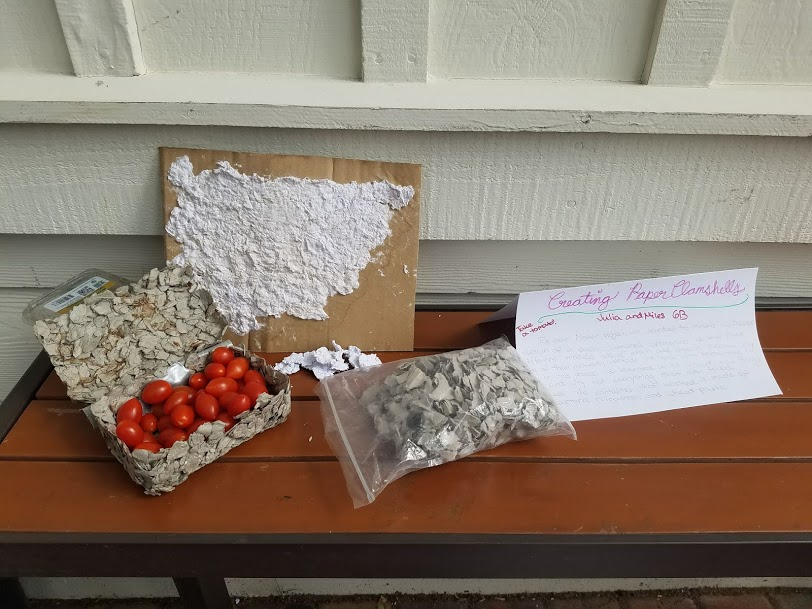
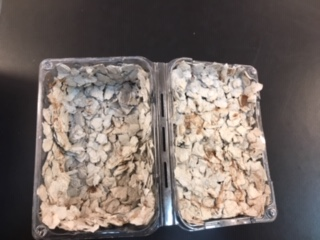
We composed two different prototypes for this project. The first was made of shredded egg cartons mixed with wheat paste, and the second, paper blended with warm water.  We did not get a chance to revise these very much: the model with the wheat paste dried and worked properly, while the other did not. (See “challenge” below.)
Putting it on the screen
One challenge that we encountered in our process was that the paper wouldn’t dry.  One of our models was made of paper pulp applied to the inside of a plastic clamshell container, brought in from home.  The problem was that the water would drain out of the paper and get stuck in the bottom of the container. Since it was plastic, there was no drainage, and the water was re-absorbed by the paper pulp.  We called this “The Plastic Effect.” There was another group who was also making paper, and theirs was drying on cardboard. When we tried putting scraps of paper into the clamshell as a liner, it only made the problem worse.  Our solution to this problem was to use different materials. Instead of using water in the paper pulp, we shredded egg cartons and mixed it them with wheat paste. This was able to dry better because the wheat paste was less liquidy and left behind more of a substance when it dried.
Our project was completely free, because we only used things that were already available to us. We brought clamshells and egg cartons in from home, and raided the school recyclings for the paper scraps. The only thing that might be an issue if you try this at home is the paper screen: we already had one at school. You can easily make one by stretching wire mesh across a picture frame or even just using an old window screen. A few links that helped us were Making Your Own Paper and Egg Carton Paper-Making.
First Prototype
We learned a lot in this process. We learned about different ways to keep paper together and different forms of recycling. We also figured out a few things about what makes plastic effective. For example, in “The Plastic Effect,” the plastic is meant to be trapping liquid, which is what makes it effective for things like milk cartons and water bottles. By figuring this out, we were able to find ways to make paper more effective, even if we weren’t able to execute them in the time given. If we had more time, we would have liked to try to mass-produce our model and make it more widely available to stores. We also would have liked to try to create models of some of the things that would have made it more effective.

Homemade organic mason jar ice cream

          6B- Ice Cream in a Mason Jar 
          By Sadie Burroughs and Amaya Heard


At the beginning of this project, we knew we wanted to make a sweet. Ice cream sounded like a fun, easy dessert that we both wanted to try making. We both knew that the summer was coming which inspired us to make something cold and sweet, like ice cream. At first, we wanted to make an ice cream machine out of cardboard, which would be our main focus. Ms. Hill said that it would be better to focus on the ice cream rather than the machine, so we decided to just make the ice cream instead. We also decided to make the ice cream in mason jars as a substitute for plastic bags. Replacing plastic bags with mason jars helps reduce plastic usage. We were going to make one ice cream vegan, and the other normal. We wanted to make the vegan ice cream so we were not using animal products. Many times, animals are not treated humanely, and we wanted to not support those businesses. We also thought that by making your own ice cream, it wouldn't cost as much as buying ice cream from a store. We estimated that the price for the ingredients was about $5-10. If we made our own ice cream, we would not be spending money on store bought ice cream in wasteful plastic.

We started off thinking we wanted to make vegan and non vegan ice cream. The ice creams would be flavored vanilla and strawberry. Sadie brought the ingredients which included heavy cream, coconut milk, and sprinkles. Black Pine Circle had sugar, vanilla extract, and mason jars. When we were trying to make the vegan ice cream, we made a mistake by only using the coconut cream and not the coconut milk. This caused it to freeze in an iceball. On the other hand, the heavy cream in the normal ice cream worked very well. We decided to make another vegan ice cream with the coconut cream and the coconut milk, but it was not thick enough. We forgot all about the strawberry ice cream, so we decided to make only vanilla. We found chocolate syrup in the fridge and decided to put chocolate in the ice cream. We tried to make vegan ice cream once more with soy milk, but it did not work out and wasn't as thick as the heavy cream ice cream, and tasted very bad. We made the ice cream by shaking all the ingredients together in a mason jar, and after five minutes, it was just like whipped cream. Then we put it in the freezer for three hours. After this, it was the consistency of normal ice cream.

I think that our project worked really well, but there are a few things that could have made it better. At first, we wanted to make vegan ice cream, but this did not work because we couldn't use heavy cream, which was a main ingredient. The alternatives did not work. An experiment I want to try in the future, is to get vegan whipped cream and put it in the freezer and see if it would turn out like the non vegan ice cream. Next time we want to make some ice cream that is vegan, maybe we should look up a good vegan recipe, instead on changing a non vegan recipe. The lesson that we learned is when you are making a new food, always make sure that you are following the recipe. Our advice for sixth graders doing this project is to make sure they have a solid plan, and do a test experiment before the final draft.


Link to recipe https://www.delish.com/cooking/recipe-ideas/recipes/a53547/mason-jar-ice-cream-recipe/

Homemade Organic Dog Treats - Sophia A. and Elliot C.


          At first, we didn't know what to make for our Maker Project. We originally wanted to make a candy machine, but we found out we couldn't do that because it didn’t help the earth in any way. Then we decided to move on to a dog feeder because we know how lazy people are when it comes to feeding their dogs, but we found out that we couldn’t do that either. We finally made up our minds and decided to make healthy organic dog treats. We wanted to make sure that dogs had the healthiest option for their treats. Some dog treats are bad for dogs and have chemicals that can harm them, but our dog treats are fully organic and won't harm the animals. Something challenging was that we would find recipes but then see that they weren't very healthy, so we had to keep searching.     
           We planned a day where we would bake our first batch of dog treats. We baked our first batch on Saturday at Elliot's house. They were a success! My dog ate three cookies. We felt successful and accomplished. We had a little trouble because Elliot was sick, so Sophia made the dough on Tuesday without Elliot, then Elliot came back on Thursday and we baked the treats. The next day it was already the Maker Faire! That morning we had two periods to finish up, in that time we made our glaze and glazed one batch of treats. We made two batches of dog treats. We made Cranberry Coconut dog treats and Peanut Butter Pumpkin Dog treats. We used Sun butter because of the allergy of someone at our school. 
          Something we learned is that, sometimes you have to edit the recipe to make them better. For the first batch of dog treats, we added 1 extra egg, 1 tbsp more almond flour, 1 tbsp more coconut flour, and 1 tbsp more coconut oil. Something else that we learned is that not all things turn out how you want them to, for example the Peanut butter Pumpkin dog treats didn't taste like we wanted them to, even though the dogs liked them.
          Even though the dog treats were a huge success and even people liked eating them, we would make them better by making them even more healthy. We could not use bacon grease next time because it has fat, we would maybe eliminate or use less peanut butter. Our project had a overall cost of $30. If you are thinking of making this make sure to follow your instincts, example: not following the whole recipe exactly. We thought that this project was really fun and enjoyed working together.
Recipes:
https://thelovelylife.org/2019/02/04/cranberry-hearts/
https://pinchofyum.com/homemade-dog-treats

Pop Tab Jewelry, Nella S.


Pop Tab Jewelry, Nella S. 6B

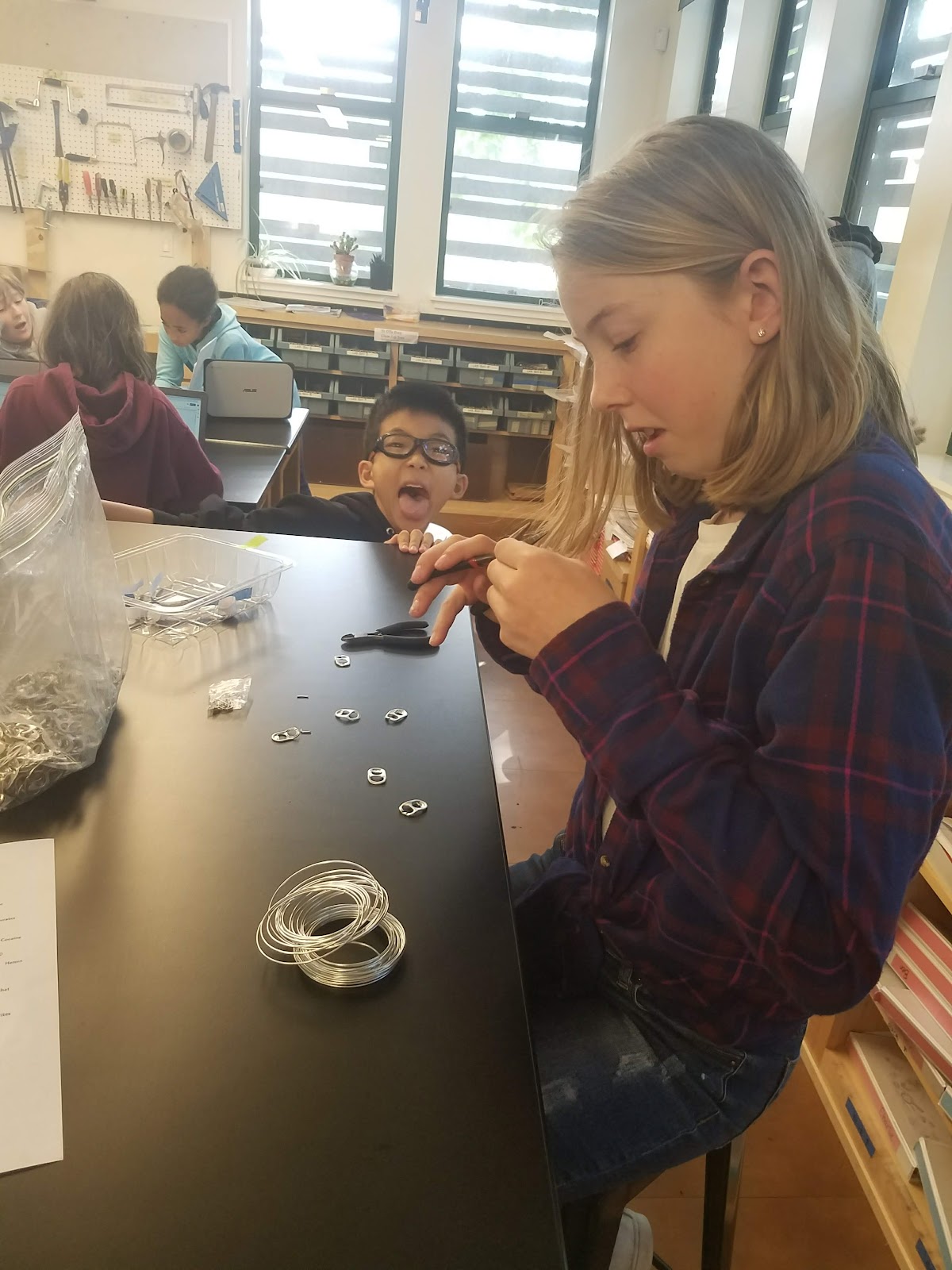
For the 2019 Maker Faire I decided to use recycled pop tabs to make jewelry. I really like working with metal and making jewelry and I recently found out that only 9% of the materials we recycle don’t actually get recycled! It’s only thrown into the landfill like regular trash. I decided to choose one recyclable material I noticed we used a lot. At first, I wanted to make jewelry out of recycled paper. But I couldn’t manipulate the paper they way I wanted to. So later I chose pop tabs and started to work with them to turn them into jewelry. Lots of people drink sodas and recycle them or throw them away. But, they can be turned into beautiful pieces of jewelry you can wear comfortably. So from there I started developing the best way to manipulate the pop tabs.

I went through many ideas and designs starting with paper quilling (the rolling and gluing of paper to make designs) than using wire to connect the pop tabs, but I finally decided on using ribbon and threading it through the pop tabs. I also used wire cutters to cut through the pop tabs and connect them but that method caused the pop tabs to become pokey so I only used it for earrings. One challenge I had to overcome was how to make the pop tab jewelry comfortable to wear. As I mentioned before directly linking the pop tabs using wire cutters caused it to become scratchy and almost painful to wear. I had to come up with another solution fast. And so I decided to use the ribbon and it made them much more stylish and comfortable to wear! I loved the look of the colorful ribbon and it seemed like everybody else did too!

To make the ribbon pop tab jewelry take a pop tab and thread the ribbon through the holes and over the middle bar. Than loop more pop tabs on to the same ribbon and continue this process until you have reached your desired length. To connect the ends just tie them together around your wrist, ankle, or neck. To make the earrings I cut through the two pop ends of the pop tabs and linked them together into fun shapes! This project was so much fun and I really recommend it for a boring rainy day weekend or any other time you need a fun craft.


I used these Pinterest pages for inspiration:

https://www.pinterest.com/pin/27936460169724105/

https://www.pinterest.com/pin/27936460169698865/

https://www.pinterest.com/pin/27936460169698837/

https://www.pinterest.com/pin/27936460166017059/

https://www.pinterest.com/pin/27936460165619051/

Simple Accessible Water Filter: DIY


Simple Accessible Water Filter

      I wanted to solve a problem that would both benefit humans and the environment, so I addressed the issue of polluted and unsafe drinking water. I know that many people in the world don’t have access to clean drinking water or a good water filter. My goal was to design an easy, inexpensive, functional product that can turn dirty water into safe drinking water so that it could be remade and reused on a global scale. But first, as you always have to do, I started small.

      I started by researching what makes a good water filter. What I found was surprising to me. I didn’t realize how easy and inexpensive this would be. Most of the resources that I used to build this, I didn’t even need to buy, (it only cost about $10-15, but I had extras of all the materials, so it could be made three or four times for the same price) and it is all contained in a small plastic water bottle. Here’s how the initial design was supposed to work. Firstly, it goes through gravel, which takes out larger things, such as leaves or insects. Then the sand gets rid of smaller particles, like dirt or algae. The activated charcoal gets rid of very fine particles and chemicals through chemical absorption. Finally, the cotton balls at the bottom strain out the residue left by the other things. So I started with that design.

   
      There were more than a few problems with my first design. First of all, it didn’t work. Dirty water going in only got dirtier as it came out. Also, the top had been cut off to put the stuff in, but if it tipped over, everything would easily spill out. And lastly, the water going in started to flood it and move things around. So I went back to the drawing board. I decided it was probably the charcoal that got the water dirtier, so I added more cotton balls at the end, but they started falling out. To fix that problem, I put the cap back onto the water bottle with a tiny hole so the water could drip out. Then, I put a coffee filter at the top, just for a bit of extra straining. Finally, to address the issue of things falling out, and the issue of flooding, I poked a small hole in a yogurt cup and attached it to the top. That meant there was something to block things from falling out, and it had a constant, slower inflow into the filter so it wouldn’t get overwhelmed.

      I tested it again by mixing dirt with water and pouring it into the filter, and it surprised me. After about 20 seconds of waiting, a constant drip of clean water came out of the bottom. It looked clean enough, so I decided to have a sip. It tasted a bit earthy, but pretty fresh and good. I think if it keeps being revised and getting better, it can be made to make water clean enough to drink safely. If you do this, keep experimenting, and try to get this project to completely work!